Working Hours : Monday to Friday 8:00 AM - 5:00 PM
Licensed Colorado Master Plumber & Master Electrician
Heat Pump Installation in the Vail Valley
Heat pumps work in cold climates. They also work differently at 7,000+ feet than they do in Denver. We engineer altitude-appropriate heating and water heating solutions for homes in Edwards, Avon, Vail, Eagle, Gypsum, and Eagle-Vail.
Speak With a Local Master
Complete plumbing & electrical scope under one single accountable contractor.
Call (970) 306-6140 No Subcontractors • Zero Hand-off DelaysAltitude Changes the Math
Air is thinner up here. At Edwards (~7,200 ft) or Vail (~8,150 ft), there is significantly less air mass per cubic foot than at sea-level manufacturer rating conditions. Sizing from a Denver-based rule of thumb gets it wrong every time.
Capacity Derating
A unit rated for a given output at sea level will not deliver that same output at high elevation. Sizing directly from the nameplate guarantees an undersized system.
5°F Cold-Climate Specs
Standard heat pumps are rated at 47°F. Cold-climate units (ccASHP) are rated down to 5°F—the rating that actually matters in a valley with below-zero nights.
Backup Heat Design
Below the equipment's effective thermal range, auxiliary systems carry the load. Proper configuration prevents unexpected spikes in your electric bill.
Ground-Source Solutions
Geothermal systems exchange heat with the ground rather than air, sidestepping the air density problem entirely for superior high-altitude efficiency.
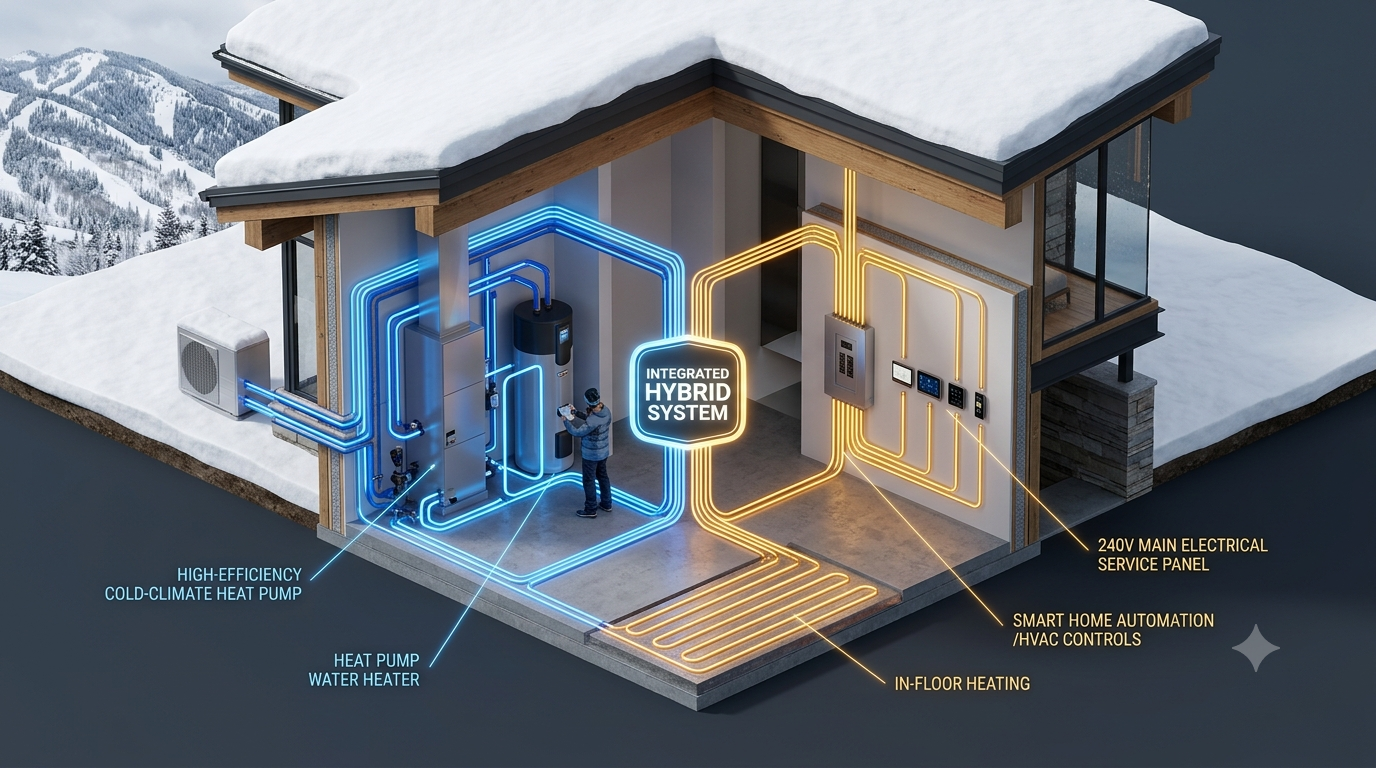
Single-Contractor Dual-Trade Architecture
Second Homes & Unoccupied Properties
A large share of Vail Valley properties sit empty for months. We engineer custom safeguards specifically for mountain homeowners and estate managers.
01
Freeze Safeguards
Custom condensate drainage with integrated heat tape protection to prevent freeze-ups during sub-zero snaps.
02
Remote Monitoring
Smart control integration allowing you or your team to verify operational status long before arriving for ski season.
03
Setback Controls
Intelligent setback programming designed to protect the home’s plumbing envelope without wasting energy.
04
Manager Coordination
Direct coordination with local estate caretakers and property management firms for total peace of mind.
Colorado Incentives Breakdown
Accurate, verified facts for Eagle County homeowners in 2026.
✓ Last verified: August 2026
| Incentive Program | Status | Details & Local Application |
|---|---|---|
| Colorado State Tax Credit | Active | Available to all Colorado residents as an upfront line-item discount through registered contractors: $1,000 for air-source heat pumps, $2,000 for ground-source, and $250 for heat pump water heaters. |
| Federal HEAR Rebates | Open (Eagle Co.) | Income-qualified point-of-sale rebates up to $8,000 for heat pumps and up to $14,000 total household cap (including panel/wiring). While Front Range funds are reserved, funding remains open for Eagle County. |
| Holy Cross Energy | Active | The Vail Valley is served by Holy Cross Energy, not Xcel Energy. Holy Cross runs independent residential rebate programs that we calculate directly into your quote. |
| Federal Tax Credits (25C/25D) | Expired | Terminated by the One Big Beautiful Bill Act signed July 4, 2025. Equipment placed in service in 2026 does not qualify for federal tax credits. |
What We Deliver
By holding both Colorado Master Plumbing and Master Electrician credentials, we handle the full scope without subcontractor delays.
- Altitude-appropriate load calculation and equipment sizing
- Cold-climate equipment selection rated at 5°F, not 47°F
- Backup heat strategy engineered for sub-zero valley nights
- Complete plumbing re-routing and 240V electrical panel scope
- Freeze protection and remote monitoring for second homes
- Verified incentive guidance based on live 2026 program status
Frequently Asked Questions
High-altitude heat pump installation insights for Eagle County.
While standard air-source heat pumps distribute forced air through ductwork, high-altitude homes with existing boilers or radiant baseboards can transition using modern air-to-water heat pumps or hybrid dual-fuel systems. An air-to-water heat pump produces hydronic hot water for radiant loops or fan coil units. For homes keeping radiant floors as primary comfort, a ductless mini-split heat pump system can also be installed alongside the hydronic setup to handle high-efficiency shoulder-season heating and provide whole-home air conditioning in summer.
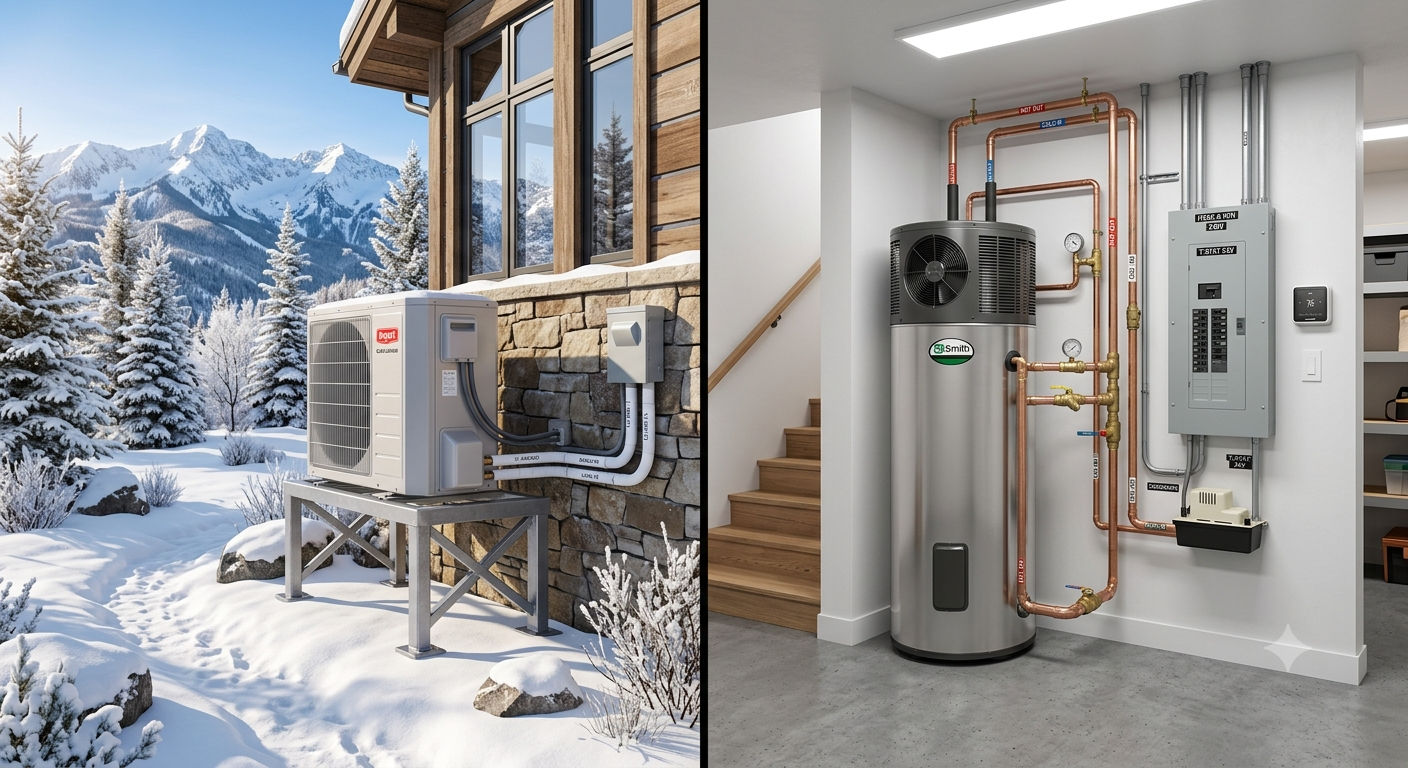
Heat pump water heaters (HPWH) extract ambient heat from surrounding air to heat water. In cold spaces like an unconditioned Vail Valley garage or subterranean mechanical room where temperatures drop significantly, ambient extraction efficiency decreases. To ensure consistent hot water without over-relying on backup resistance coils, we either duct the intake/exhaust air to warmer internal zones or program dual-mode operation, allowing the unit to pull heat efficiently during winter while simultaneously dehumidifying basement utility spaces.
Because heat pumps move heat rather than generate it through combustion, modern inverter-driven units achieve coefficient of performance (COP) ratings of 2.0 to 3.5 even in winter. When replacing high-cost delivered fuels like propane or resistance electric heat, operating costs drop noticeably. When replacing natural gas, operational cost parity depends on Holy Cross Energy’s electricity rate tiers vs. gas rates; however, overall seasonal efficiency gains—combined with reduced summer cooling costs—often yield net operational savings across the year.
It depends on your current panel capacity. Converting both space heating and water heating to electric heat pumps typically requires dedicated 240V, 30A to 50A circuits. Many homes in Eagle County with 100A or 150A main panels need a service panel upgrade to 200A to safely carry the added continuous load. Because we handle both master plumbing and master electrical scope, panel upgrades and wiring are completed simultaneously with the heat pump installation without requiring separate subcontractors.
High-altitude mountain environments present rapid frost conditions. Modern cold-climate heat pumps feature intelligent demand-defrost algorithms that run brief heating cycles to clear coils only when sensor ice buildup is detected, minimizing energy waste. Outdoor condenser units are elevated on 18-inch to 24-inch snow stands or wall brackets, positioning them safely above local Eagle County snowdrifts and roof driplines to maintain unimpeded airflow throughout heavy winter storms.